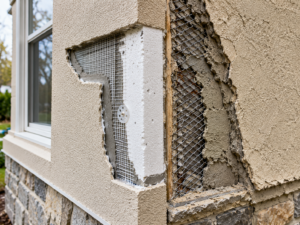


A pristine, freshly painted stucco facade can easily hide a catastrophic structural failure directly beneath its surface. Because stucco is an incredibly rigid, cementitious material, water can become trapped behind the outer shell for years without ever showing a single sign of bubbling or peeling on the outside. By the time a brown water stain appears on your interior drywall, the wooden framing supporting your home has likely been rotting for over a decade. Securing highly technical moisture diagnostics and targeted stucco repair is the only way to identify and isolate these hidden vulnerabilities before they condemn your entire building envelope.
Why Visual Inspections Fail for Stucco Homes
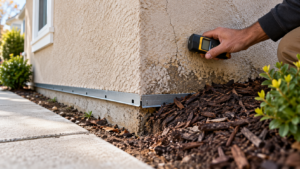
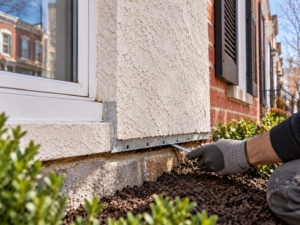
Many homeowners rely on standard home inspectors who merely look at the exterior wall for visible cracks. This visual guesswork is entirely inadequate for stucco systems. A true facade specialist performs “invasive moisture testing.” This involves drilling tiny, microscopic holes (usually 1/4-inch) through the stucco layer in high-risk areas—such as beneath windows and roof intersections. We insert advanced moisture probes directly into the wooden sheathing behind the wall to measure the exact moisture content. If the reading is above 19%, structural rot is actively occurring, and an immediate intervention is required.
Addressing Structural Rot and Municipal Code Standards
If invasive testing reveals that the underlying plywood sheathing and load-bearing studs have turned to mush, the damaged stucco must be torn down and the structural framing rebuilt. Homeowners planning structural repairs, renovations, or major remodeling work can review Philadelphia’s building and repair permit guidance through the City of Philadelphia. Securing proper documentation ensures that your rebuilt framing and modernized water-resistive barrier (WRB) satisfy all municipal safety and engineering protocols.
Elite Diagnostic and Remediation Services We Offer
We replace guesswork with absolute scientific certainty, providing:
- Comprehensive invasive moisture probing and substrate resistance testing.
- Thermal imaging diagnostics to trace hidden water migration paths.
- Micro-drilled hole sealing with high-grade, color-matched elastomeric caulk.
- Full-scale tear-downs and targeted structural wood rot replacement.
Neighborhoods Where We Perform Deep Diagnostics
Our certified exterior testing crews are dispatched directly to properties in:
- Chestnut Hill
- Mount Airy
- Roxborough
- Manayunk
Frequently Asked Questions
Will invasive moisture testing damage the look of my house?
No. The test holes we drill are incredibly small—about the diameter of a pencil. Once the moisture reading is taken, we immediately fill the holes with a premium, color-matched sealant, making them virtually invisible from just a few feet away.
What is an acceptable moisture reading behind a stucco wall?
A healthy wall cavity should read between 8% and 14% moisture content. Readings between 15% and 18% require close monitoring, while anything consistently registering above 19% indicates active decay and mold growth.
If my house fails a moisture test, do I have to replace all the stucco?
Not always. If the water intrusion is highly localized—for instance, only occurring beneath a single master bedroom window—we can perform a surgical, localized remediation rather than tearing down the entire elevation.