

When exterior wall defects appear on residential properties across Fishtown, Northern Liberties, and Port Richmond, property owners face a high-stakes construction decision: can the damage be resolved with a localized surface repair, or does the building require full or partial stucco remediation? Because the term “remediation” implies a major construction project involving cladding removal and framing restoration, homeowners understandably want to avoid unnecessary work. However, applying cosmetic patches over an actively failing wall assembly guarantees continued moisture destruction. Understanding how professionals evaluate the complete building envelope allows you to align your project scope with the actual mechanical condition of your home.
Understanding the Difference Between Repair and Remediation
To evaluate construction proposals accurately, property owners must understand the operational distinctions between these two service categories:
- Stucco Repair: A targeted, localized intervention designed to correct surface-level damage, minor impact chips, hairline settlement cracking, or isolated flashing deterioration where the underlying building envelope remains dry and structurally sound.
- Stucco Remediation: A comprehensive structural restoration process that involves removing the existing stucco cladding down to the wood sheathing, correcting underlying timber rot, installing a modern, continuous weather-resistant barrier (WRB) and drainage plane, and applying an engineered exterior cladding system.
When Localized Stucco Repair Is the Appropriate Scope
Targeted repair is the most cost-effective and practical solution when diagnostic evaluation confirms that moisture has not penetrated the underlying wood framing. If your property exhibits minor cracking from seasonal shrinkage, isolated impact damage from patio equipment, or localized wear along a dry architectural expansion joint, stripping the entire facade is unnecessary. In these scenarios, technicians excise the damaged material, repair the metal wire lath if needed, apply bonding agents, and trowel fresh base and finish coats that blend with the surrounding wall texture.
Conditions That Justify Full or Partial Remediation
Remediation becomes necessary when visual symptoms and moisture diagnostics confirm systemic failure within the concealed wall assembly. Conditions that indicate a broader removal scope is required include:
- Widespread Wood Sheathing Rot: When invasive moisture testing reveals that the oriented strand board (OSB) or plywood sheathing behind the stucco has sustained moisture content exceeding twenty percent over extended periods, the timber is actively decaying and must be replaced.
- Missing or Defective Window Flashing: If windows and doors were originally installed without integrated metal pan flashing or proper head flashing, rainwater running down the facade continuously bypasses the cladding and drains directly into the wall cavity.
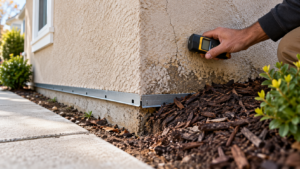
- Absence of a Weep Screed Drainage Plane: Traditional stucco absorbs small amounts of moisture, which must be allowed to drain down the weather barrier and exit at the bottom of the wall. If the original installation omitted a foundation weep screed, trapped water pools at the base of the wall, rotting bottom framing plates and floor joists.
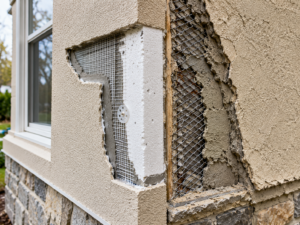
- Chronic Delamination and Bulging: When large sections of stucco separate from the reinforcing wire lath across multiple stories, the cladding has lost its structural anchorage and presents a severe falling hazard.
Why The Visible Finish Is Only One Component of the Wall
A common error in exterior property management is treating stucco as a solid, standalone barrier. In residential construction, stucco is simply the outer skin of an interdependent multi-layer building envelope. A functional stucco wall relies on exterior paint or color coats, traditional brown and scratch cement coats, metal wire or fiberglass lath, two layers of asphalt-saturated building paper or commercial house wrap, and structural timber sheathing.
If water breaches the outer cement skin due to failed sealants or missing flashing, applying a fresh layer of stucco directly over the old surface simply seals the moisture inside the wall. Adhering to EPA residential moisture-control standards, permanently resolving exterior wall decay requires removing moisture-retentive materials, establishing an unobstructed vertical drainage plane, and ensuring that timber framing is completely dry before new cladding is installed.
Why Repair Scopes Can Evolve After Cladding Removal
Because exterior contractors cannot see through solid concrete, initial estimates are based on visual inspections, moisture-meter diagnostics, and architectural history. When a remediation project commences and the heavy stucco shell is removed, the true condition of the framing is revealed.
If removing a section of cladding exposes extensive termite damage or framing rot extending around a building corner into an adjacent wall, the construction scope must adapt to ensure structural integrity. A transparent, professional contractor documents these possibilities upfront, providing clear hourly or unit-cost allowances for sheathing replacement and framing carpentry in their initial written proposal.
By partnering with an experienced team for professional stucco remediation in Philadelphia, you ensure your property is evaluated as a complete structural system. Whether your home requires targeted stucco repair solutions or a complete exterior envelope restoration, Philadelphia Stucco Experts delivers precision craftsmanship designed to protect your investment. Contact our team today to schedule an expert on-site wall assessment.
What is the difference between stucco repair and stucco remediation? Stucco repair involves patching surface cracks, chips, and localized defects on healthy walls. Stucco remediation involves removing the existing cladding entirely to repair rotted wood sheathing, install proper waterproofing and drainage planes, and rebuild the exterior wall system.
Why is my stucco contractor recommending remediation instead of a simple patch? Contractors recommend remediation when diagnostic testing or visual evidence—such as chronic water staining, spongy walls, or missing window flashing—proves that moisture is actively destroying the structural wood framing beneath the visible stucco finish.
Can new stucco be applied directly over old, cracked stucco to save money? No. Applying a new layer of stucco over an existing, damaged system adds excessive dead weight to the framing, conceals underlying structural wood rot, and traps moisture inside the wall cavity, leading to rapid system failure.
Why might the cost of a remediation project change after work begins? Because the exact extent of timber sheathing rot and framing decay is hidden beneath the solid stucco shell, removing the cladding can uncover structural damage that requires additional carpentry restoration not visible during the initial inspection.
How does a weep screed prevent moisture damage inside a stucco wall? A weep screed is a perforated metal drainage track installed at the base of the stucco wall. It allows any moisture that penetrates the porous stucco and runs down the internal weather barrier to exit safely to the exterior instead of pooling and rotting wood framing.