

Why roof-to-wall intersections deserve special attention
When a sloped roof terminates against a vertical stucco wall, rainwater has to be directed away from the wall and into the gutter or drainage path. The small piece of flashing that redirects this concentrated runoff at the lower end of the roof-to-wall junction is commonly called kick-out flashing.
If that transition is missing, too short, damaged, or buried by later stucco work, water can run behind the cladding instead of into the gutter. Because the volume is concentrated at one point, the resulting moisture damage may extend far below the visible roofline before the homeowner realizes there is a problem.
The symptom may appear far from the flashing
Water entering behind stucco can travel along sheathing, framing, or building paper before showing up as an interior stain. Exterior symptoms may include dark staining below the roof edge, soft trim, cracking, efflorescence, swollen wood, or repeated sealant failure near the gutter end.
These symptoms do not automatically prove the kick-out detail is the only problem. The roof flashing, gutter position, stucco termination, weather-resistive barrier, and underlying sheathing all need to be considered together.
Why caulk alone is not a drainage strategy
Homeowners sometimes see a gap near the roofline and respond by adding more exterior caulk. Sealant may be part of a correctly designed joint, but it cannot substitute for flashing that physically directs water out of the wall assembly. Thick surface caulk can also make future inspection harder if it hides how the components are actually layered.
A durable repair should restore drainage first. The exact method depends on the roof and wall assembly, but the goal is to create a clear path that moves roof runoff into the gutter while allowing the stucco system to terminate correctly around the flashing.
Repair may require coordinated roofing and stucco work
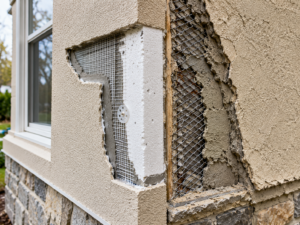
Correcting a failed roof-to-wall intersection can involve more than one trade. Roofing may need to be lifted or modified to integrate step flashing and the kick-out. Stucco may need to be removed locally so the underlying weather-resistive layers can be inspected and properly tied into the new detail.
This is why cosmetic surface patching often fails at complex transitions. If the water path begins behind the exterior finish, the repair has to reach the layer where that path starts.
Inspect the sheathing before closing the wall
When the area is opened, the contractor should look for staining, soft sheathing, damaged framing, deteriorated trim, or evidence of repeated wetting. A small exterior defect can sometimes create a larger hidden repair if it has been active for years.
If the substrate is sound, the scope may remain localized. If deterioration extends beyond the opening, the homeowner should receive an updated repair plan rather than having new stucco installed over compromised material.

A transition detail is part of the whole moisture-management system
Philadelphia Stucco Experts lists leaks at rooflines, parapets, and wall transitions among the problems it repairs. Kick-out flashing is a good example of why those transitions matter: a small metal detail can determine whether water is discharged harmlessly or driven behind the facade.
If you see staining, cracking, soft trim, or recurring repairs where a roof meets a stucco wall, a moisture-first inspection can help determine whether the visible damage is the source or only the symptom.
Frequently Asked Questions
What does kick-out flashing do?
It redirects concentrated roof runoff away from a wall and toward the gutter at the lower end of a roof-to-wall intersection.
Can I fix the area with caulk only?
Not when the underlying problem is missing or failed flashing. A durable repair must restore the water-management path.
Why does damage show up below the roofline?
Water can travel behind stucco and along sheathing or framing before becoming visible.