
It is often said in the construction industry that there are two types of concrete and stucco: the kind that has cracked, and the kind that is going to crack. Because traditional cement stucco is a rigid, heavy material, minor cracking is an inevitable result of curing shrinkage and the natural settling of the home’s foundation.
However, ignoring these fissures allows wind-driven rain to penetrate the exterior. Performing expert stucco crack repair in Philadelphia requires distinguishing between harmless hairline shrinkage and structural movement that threatens the building envelope.
Diagnosing the Type of Crack
Before any patching material is mixed, a professional must evaluate the width, pattern, and location of the crack.
- Hairline Cracks (Shrinkage): These are extremely thin (less than 1/16th of an inch) and typically look like a spiderweb. They are caused by the water evaporating too quickly when the stucco was originally applied.
- Stair-Step Cracks: If the cracks look like steps, especially near the corners of windows or doors, this indicates structural movement or settling of the foundation.
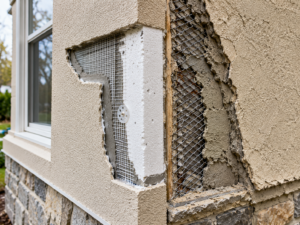
- Wide Cracks: Any crack wider than a credit card is a serious concern. It usually means the metal lath beneath the stucco has failed, or moisture has penetrated, frozen, and expanded, pushing the stucco outward.
The Professional Repair Process
The most common mistake homeowners and amateur handymen make is simply squeezing a bead of silicone caulk over the crack. Silicone cannot be painted, it attracts dirt, and it will peel off within a year.
1. Routing and Preparation
For cracks wider than a hairline, the crack must be mechanically widened. A technician uses a grinder with a masonry blade to open the crack into a “V” shape. This removes crumbling edges and creates a clean, solid surface for the new patching material to grip. The area is then brushed and blown clean of all dust.
2. Application of Elastomeric Sealants
Instead of using rigid cement, which will simply crack again when the house shifts, professionals use high-grade elastomeric sealants. These specialized caulks are designed to stretch and compress up to 300% without breaking. The sealant is forced deep into the routed crack.
3. Texturing and Blending
To ensure the repair is invisible, the wet sealant is “tooled” and sometimes dusted with a fine aggregate (sand) to match the exact texture of the surrounding traditional stucco. Once cured, the repaired area is primed and painted with a breathable masonry coating, fully restoring the home’s aesthetic and waterproofing.
CTA
Don’t let minor cracks become major leaks. Contact Philadelphia Stucco Experts today for professional crack repair that blends flawlessly and protects your exterior.