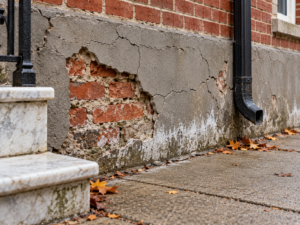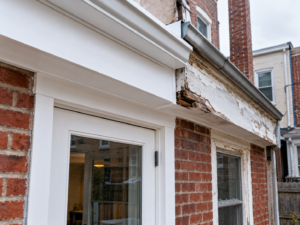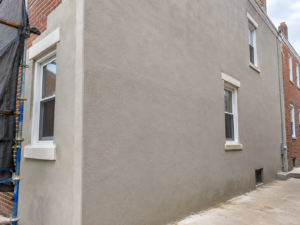

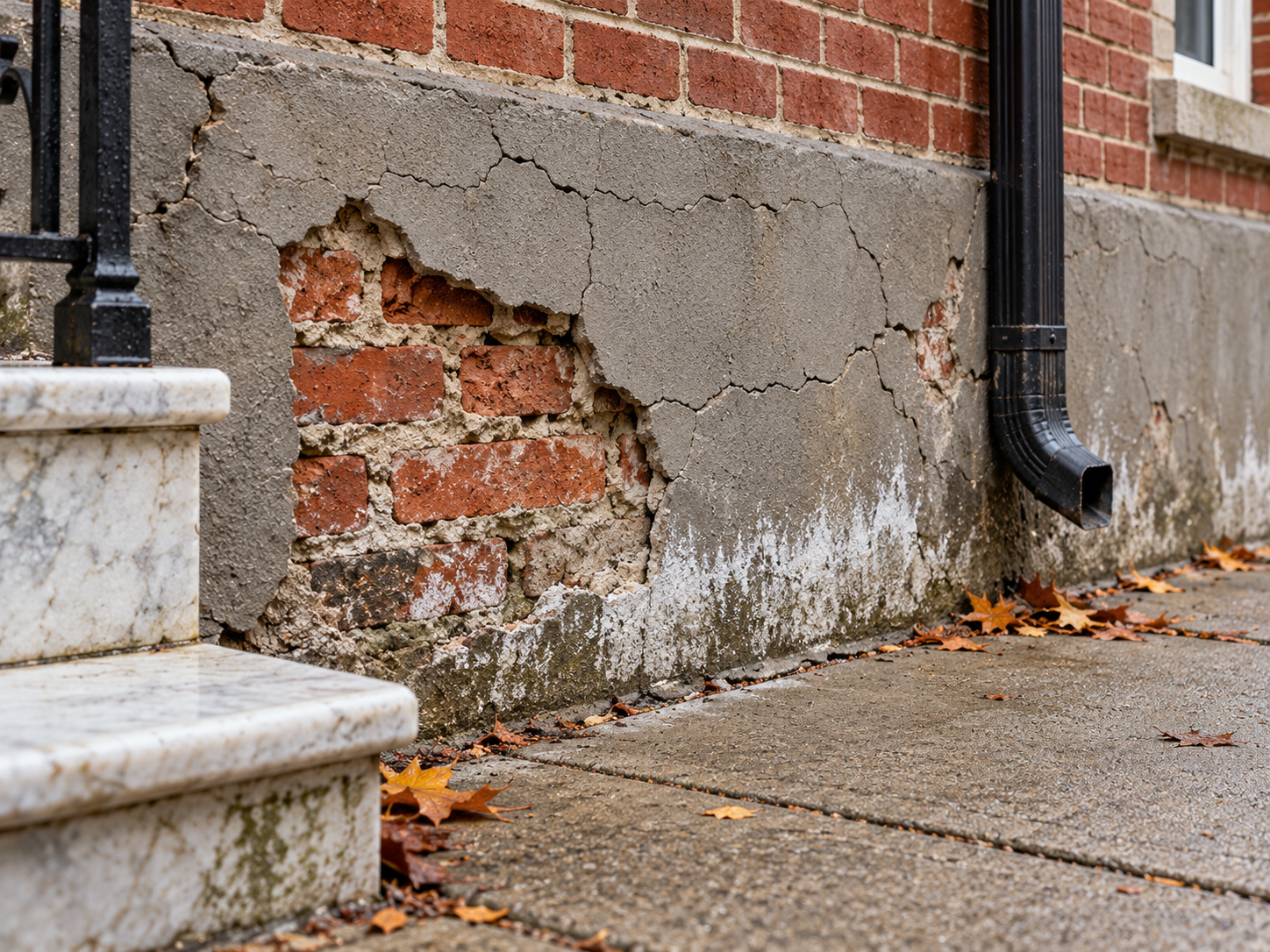
Walk the block in Germantown, Mount Airy, Roxborough, Kensington or South Philadelphia and you will see it on almost every house: a band of gray cementitious coating covering the lower part of the wall, from the sidewalk or yard up to the first-floor sill. That coating is parging. On many older Philadelphia homes it was troweled over brick or fieldstone foundations to smooth the surface, shed water and give the base of the house a cleaner look. Over decades, it cracks, bulges, stains white and falls away in sheets.
The tempting fix is a bag of patching mix. Unfortunately, parging that fails once usually fails for a reason, and a quick patch over wet, salty masonry tends to come off again within a season or two. This guide explains why parging fails, why patching over damp masonry rarely holds, and how a durable repair is planned.
What Parging Is and Why Old Homes Have It
Parging is a thin coat of mortar-like material applied directly to masonry. It is closely related to stucco and is usually made from mixtures of sand, lime, cement or a combination. On a Philadelphia foundation, parging typically does a few jobs:
- Covers rough foundation masonry. Fieldstone and common brick foundations were rarely meant to be seen up close.
- Sheds rain and splash-back at the base of the wall, where water from sidewalks, stoops and downspouts hits hardest.
- Evens out the transition between a stone or brick foundation and the wall above.
The important point is that parging is a sacrificial skin, not a waterproofing membrane. It is supposed to wear slowly and protect the masonry behind it. When it is made from a mix that is too hard or too dense for the wall, it can end up trapping moisture and damaging the very masonry it was meant to protect.
Common Signs Your Parging Is Failing
Foundation parging rarely fails all at once. Most homeowners notice a combination of these symptoms:
- Hairline and map cracking across the surface, often more visible after rain.
- Wider cracks that follow mortar joints, run diagonally from a corner, or line up with a basement window.
- Hollow sounds when the coating is tapped lightly, a sign it has lost its bond to the masonry.
- Bulging or blistering where the coating has separated and pushed outward.
- Sheets falling off, sometimes taking the outer face of soft brick with them.
- White, powdery deposits (efflorescence) on the parging or on the exposed masonry beneath it.
A few cracks do not mean the whole coating must go, but hollow areas and recurring stains are worth photographing and dating.
Why Parging Cracks and Delaminates
According to the National Park Service’s Preservation Brief 39 on controlling unwanted moisture in historic buildings, below-grade ground moisture is a major source of unwanted moisture in older buildings, and saturated foundation walls generally pull that moisture up within the wall, eventually deteriorating the masonry. The brief points to leaking downspout drainage, poorly compacted backfill against the foundation, unsealed pipe penetrations and irrigation set too close to the building as common contributors. On a Philadelphia rowhome, the usual suspects at the base of the wall include:
- Downspouts that discharge right at the foundation or into a cracked or clogged underground drain.
- Sidewalks and patios that slope toward the house instead of away from it.
- Splash-back from concrete, stoops and areaways during heavy rain.
- Soil, mulch or planting beds piled against the wall.
- Basement humidity and vapor drive from laundry and furnaces.
- Freeze-thaw cycles that expand trapped water behind the coating every winter.
Settlement cracks and hard, rigid cement patches over soft masonry can also open paths for water. Many old Philadelphia foundations carry several layers of mismatched patches, each moving and drying differently.
Moisture and Efflorescence at the Base of the Wall
Efflorescence is the white, chalky residue left when water moves through masonry, carries dissolved salts to the surface and evaporates. The NPS moisture brief describes how walls with rising damp often show a whitish horizontal tide mark of efflorescence that fluctuates seasonally about 1 to 3 feet above grade, and notes that these salts make the masonry even more sensitive to moisture. If it returns after every wet spell, water is still traveling through that wall.
Salts matter for repairs because they do more than stain. As they crystallize inside or behind a coating, they can push it away from the masonry. Before deciding on materials, it helps to understand where the water is coming from: below grade, from the surface, from inside the basement, or from all three.
Why Patching Over Damp Masonry Fails
This is where many repairs go wrong. Old foundation masonry needs to be clean, sound and properly prepared before new material goes on, and the source of the moisture needs to be addressed first. Preservation Brief 39 lists the first steps for keeping a foundation drier: slope grades away from the building, carry downspout water well away, provide drainage where there are no gutters, and reduce splash-back onto foundation walls. It adds that excavation, dampproof coatings and footing drains should come only after those measures.
There is an important difference between prepared masonry and wet masonry. A skilled plasterer will often dampen a sound masonry surface before applying a patch so that it does not pull water out of the new material too quickly. That is routine preparation. The problem is masonry that stays saturated because of a drainage or groundwater issue. Patching over that kind of wall tends to fail for several reasons:
- The bond never forms properly on dirty, crumbling or salt-laden masonry.
- Moisture keeps moving through the wall and pushes behind the new patch.
- Salts keep crystallizing at the new interface.
- Bonding agents may not hold on a wall that stays damp or carries heavy salt loads.
- Cold-weather work struggles. Masonry coatings need time to cure, and frost can ruin fresh work.
In practice, fix the water first and remove loose material back to sound masonry before new parging goes on.
Choosing Breathable Materials for Old Brick and Stone
Many Philadelphia foundations were built with soft brick or fieldstone laid in lime-rich mortar. These walls were designed to absorb some moisture and let it dry out again. A very hard, dense cement coating can stop that drying at the surface, forcing water and salts to escape through the brick or mortar instead.
The NPS moisture brief warns that moisture should not be sealed into a damp wall with a waterproof coating such as cement parging applied to the inside of damp walls, because that forces capillary rise and its damage higher up the wall. It also cautions against sealing a building so completely that it cannot breathe. A common masonry rule of thumb is that a repair material should be somewhat softer and more permeable than the masonry behind it. For foundation parging, that often points toward:
- Lime-based or lime-rich mixes on older soft brick and stone, where appropriate.
- Avoiding non-breathable coatings, sealers or paints over parging on walls with moisture issues.
- Matching the existing system when only part of the coating is being repaired.
- Testing first with small trial areas before committing to a whole wall.
Newer concrete or block foundations may tolerate a different mix; the right material depends on what the wall is actually made of.
How a Durable Parging Repair Is Planned
Every foundation is different, but a lasting repair generally follows a sequence like this:
- Inspect and sound the wall. Tap the coating to map hollow areas and check the interior side of the basement wall for dampness.
- Fix the water first. Correct downspouts, grading, sidewalk pitch, planting beds and any leaks feeding the wall.
- Remove loose material. Cut back delaminated parging to sound edges without damaging the masonry beneath.
- Repair the masonry. Repoint open joints and replace badly deteriorated units where needed.
- Select a compatible mix. Choose a material suited to the brick, stone or block behind it.
- Apply in proper coats over a clean, prepared surface, keyed for bond.
- Cure carefully. Protect new work from fast drying, hot sun and freezing temperatures.
If the property is in a historic district or on the Philadelphia Register of Historic Places, or if you are changing the look of a street-facing wall, confirm with the Philadelphia Historical Commission and L&I whether review or permits apply before work begins.
Frequently Asked Questions
What is the difference between parging and stucco? Both are mortar-like coatings applied to walls. Parging usually refers to a thinner coat over foundation masonry, while stucco typically covers larger wall areas, often in multiple coats.
Can I just patch the cracked spots myself? Small cosmetic cracks on a dry, sound wall can sometimes be handled locally. If the coating sounds hollow, keeps falling off or shows recurring white stains, the moisture source should be found first, or the patch will likely fail.
Should parging be waterproof? Parging helps shed water, but on old brick and stone foundations it generally should allow the wall to dry. Sealing it with a non-breathable coating can trap moisture in the masonry.
Why does white powder keep coming back on my foundation? Recurring efflorescence means water is still moving through the masonry and carrying salts to the surface. Look at drainage, downspouts and basement humidity before repairing the coating.
When is the right time of year to repair parging? Mild, dry weather is preferred, because fresh parging should not freeze while it cures. Late fall and winter repairs in Philadelphia need careful scheduling with your contractor.
If the parging on your foundation is cracking, sounding hollow or shedding in sheets, Philadelphia Stucco Experts LLC can assess the wall, help identify where the moisture is coming from and recommend a compatible repair approach for your brick, stone or block foundation. Learn more about our stucco installation and repair services in Philadelphia and request an estimate before another freeze-thaw season goes to work on the base of your wall.