If you’re searching stucco repair Philadelphia or stucco contractor near me, the real goal isn’t just making the wall look smooth again—it’s stopping moisture from traveling behind the stucco and damaging the substrate. On Philadelphia rowhomes, most failures happen at transitions: windows, doors, roof-to-wall intersections, parapet caps, and any place sealants or flashing details break down.
Winter is when problems become visible. Cracks widen, sealant lines separate, and moisture can enter behind the finish. Then, as temperatures rise, homeowners often see bubbling paint, staining, interior musty odors, or soft spots. That’s why early, correct repair is so important.
Why “small cracks” can become big moisture problems
Stucco is a system. Even hairline cracks can allow water to enter, especially when:
- The wall gets repeated wetting from wind-driven rain
- Freeze/thaw cycles expand cracks and loosen edges
- Sealants fail around windows and penetrations
- Flashing transitions weren’t installed correctly
Water can move behind the surface and travel until it finds an exit point—often far from where it entered. That’s why the interior stain location is rarely the actual entry point.
The most common stucco failure points on Philly homes
1) Window and door corners
Corners concentrate movement and stress. If sealant lines are old, separated, or missing backer rod, water finds the gap.
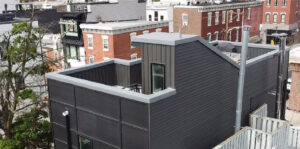
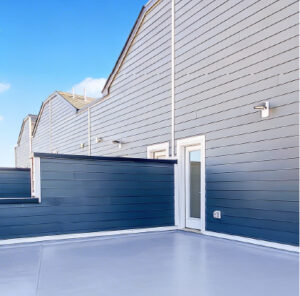
2) Roof-to-wall and parapet transitions
Parapet caps, counterflashing, and roof edge details are frequent culprits. If water enters at the top, it can travel down behind the stucco.
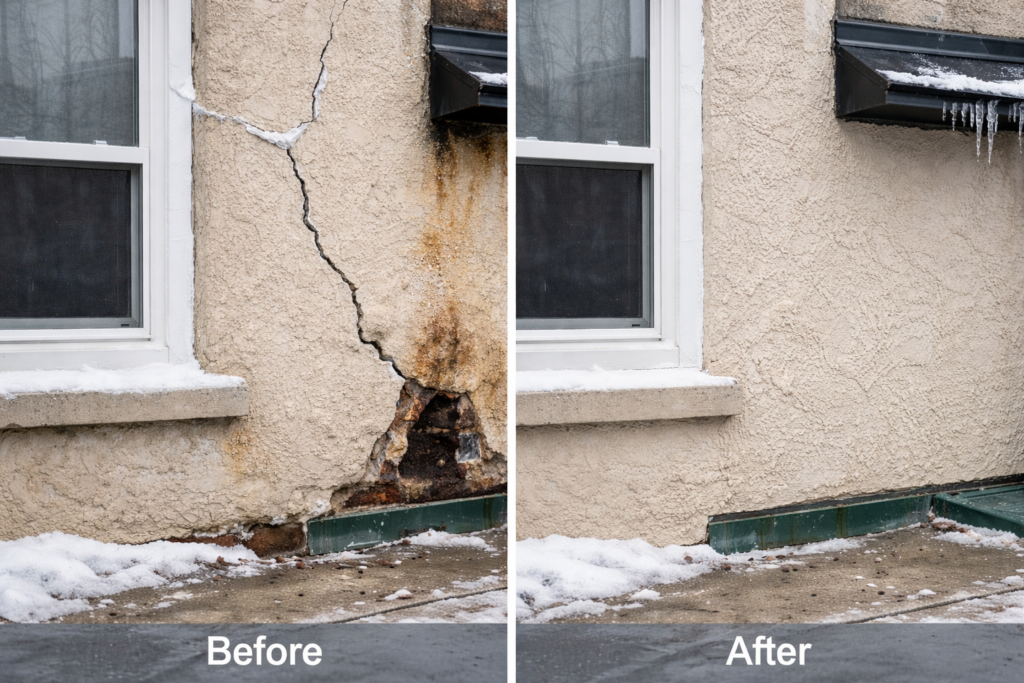
3) Base terminations and lower-wall moisture
If the bottom edge traps moisture, you can get soft substrate, crumbling finishes, and persistent staining.
4) Penetrations and attachments
Light fixtures, hose bibs, vents, and cables are small openings that become big leak paths if not sealed properly.
Proper stucco repair: what “good” looks like
A durable repair is not “patch + paint.” It should include:
- Identifying the true entry point (not just the visible stain)
- Removing loose or compromised material to reach a stable edge
- Repairing substrate issues if the wall is soft or deteriorated
- Rebuilding the patch with correct bonding and finish texture
- Sealing transitions correctly (backer rod + compatible sealant where needed)
- Checking flashing details at critical edges
Repair vs remediation: the simple decision rule
Repair makes sense when:
- Damage is localized
- Substrate is solid
- Moisture is not repeating in multiple areas
Remediation is more likely when:
- Multiple areas show staining or bubbling
- Substrate is soft
- Moisture keeps returning after “repairs”
- There’s evidence of trapped water behind large sections
Neighborhood service focus
We support stucco repairs and moisture-focused solutions across Fishtown, Kensington, Port Richmond, Northern Liberties, and West Philadelphia.
Internal links
- Home: https://philadelphiastuccoexperts.com/
- Portfolio: https://philadelphiastuccoexperts.com/portfolio/
- Contact: https://philadelphiastuccoexperts.com/contact/
FAQ (for schema)
Is stucco waterproof by itself?
No. Stucco resists water but relies on correct flashing, transitions, and sealants to keep moisture out.
Can I just paint over cracked stucco?
Paint may hide cracks temporarily, but it won’t stop water intrusion if the system is failing.