Winter is when stucco problems become obvious. A hairline crack that looked “fine” in October can turn into staining, bubbling, or soft spots by January—especially after repeated wind-driven rain and freeze/thaw cycles. In Philadelphia and nearby suburbs, stucco exteriors are common on certain home styles, additions, and newer builds, and the failures we see are usually tied to one thing: moisture getting behind the surface.
This guide breaks down what winter does to stucco, what warning signs mean, and what repairs actually protect your home—not just the appearance.
Why winter makes stucco problems show up
Stucco is a durable exterior finish, but it depends on proper detailing. In winter, the combination of moisture and temperature swings creates stress:
- Freeze/thaw cycles can widen cracks and open seams.
- Wind-driven rain pushes water into gaps that stay dry during calmer seasons.
- Slow drying (less sun, colder days) means moisture lingers longer behind the stucco surface.
- Expansion/contraction of materials around windows, doors, and corners can break sealant joints.
If stucco is already compromised—even slightly—winter tends to reveal it.
Common winter warning signs of stucco failure
Not every crack means your wall is “ruined,” but certain patterns are red flags:
Watch for:
- Diagonal cracks radiating from window or door corners
- Staining or dark streaks below penetrations and trim
- Bubbling/blistering paint on stucco-coated surfaces
- Soft or “spongy” areas when lightly pressed (do not push hard)
- Efflorescence (white, powdery residue) indicating moisture movement
- Cracks that recur after previous patching
A key point: the visible damage is often not where the water is entering. Moisture can travel behind the surface until it finds a weak exit point.
Why quick patching sometimes fails
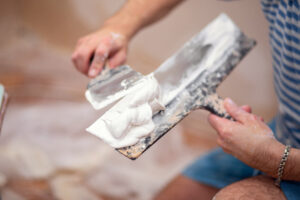
The most common mistake is treating stucco like cosmetic plaster—fill the crack, paint it, done. That can work for very minor surface cracking, but if the crack is caused by movement, failed sealant, or water entry, it returns.
Patches fail when:
- The underlying detail (flashing or joint) is still leaking
- Sealant joints were never corrected around windows/doors
- The repair material doesn’t bond correctly to the existing finish
- Water is entering at a different location and exiting at the crack
The goal is not just “make it look smooth.” The goal is stop moisture entry and restore integrity.
The highest-risk areas on stucco homes
If you want to prioritize inspections and repairs, focus on locations where moisture entry is most likely:
1) Windows and doors
Corners and perimeters are stress points. Poorly detailed transitions are a top cause of ongoing cracking.
2) Roof-to-wall transitions and step flashing
Where a roof edge meets stucco, the detail must manage water correctly. Small failures here can cause major interior staining.
3) Penetrations
Hose bibs, vents, exterior lights, and cables often have gaps that let water behind the stucco.
4) Bottom edges and grade transitions
Where stucco meets ground, concrete, or a porch slab, moisture can wick upward if the edge isn’t detailed properly.
5) Sealant joints
Sealant is not “extra.” It’s part of the system. When it fails, water gets in.
What “good stucco repair” actually includes
A strong repair approach usually follows a sequence:
- Diagnose the cause (movement vs. impact vs. moisture entry)
- Identify the entry path (joints, flashing, penetrations, transitions)
- Repair the system detail (not only the surface)
- Patch and blend stucco properly for texture match and durability
- Re-seal joints as needed with correct materials
- Finish appropriately (sometimes with recoating/paint where relevant)
That’s the difference between a repair that lasts and a repair that becomes a yearly routine.
When to consider deeper remediation
Some homes don’t need remediation. Others do. If you have multiple warning signs—soft spots, widespread staining, recurring cracks, and moisture indications—then a deeper plan may be needed. The earlier you identify these patterns, the more controlled (and cost-effective) the solution tends to be.
Philadelphia Stucco Experts focus on practical, moisture-aware repairs that address the source—not just surface appearance—so your exterior performs through winter and beyond.